


Introducing SelfRx™ — prescribe peptides and other substances to yourself.
EDIT: This was an April Fools joke, but read on for some thoughts about how we help patients navigate pharmacy in the age of AI.
April 1, 2026 — Brooklyn, NY — Today I'm excited to announce SelfRx™, AI-powered peptide prescribing and fulfillment built into Photon — the first eRx network to support peptides. Tell us what's wrong or just tell us what you want. Our AI writes the prescription for free and sends it to you via text. Tap the link to compare between suppliers and checkout. The whole thing takes less time than booking a doctor's appointment — because there is no doctor.
The Photon Marketplace already helps millions of patients shop between licensed domestic pharmacies. Now you can navigate vetted international peptide suppliers from Shenzhen to Hyderabad. The experience includes full price transparency, purity scores, and estimated delivery times. It's just like shopping between real pharmacies for a real prescription, but it's peptides. You can even send a peptide prescription to friends and family.
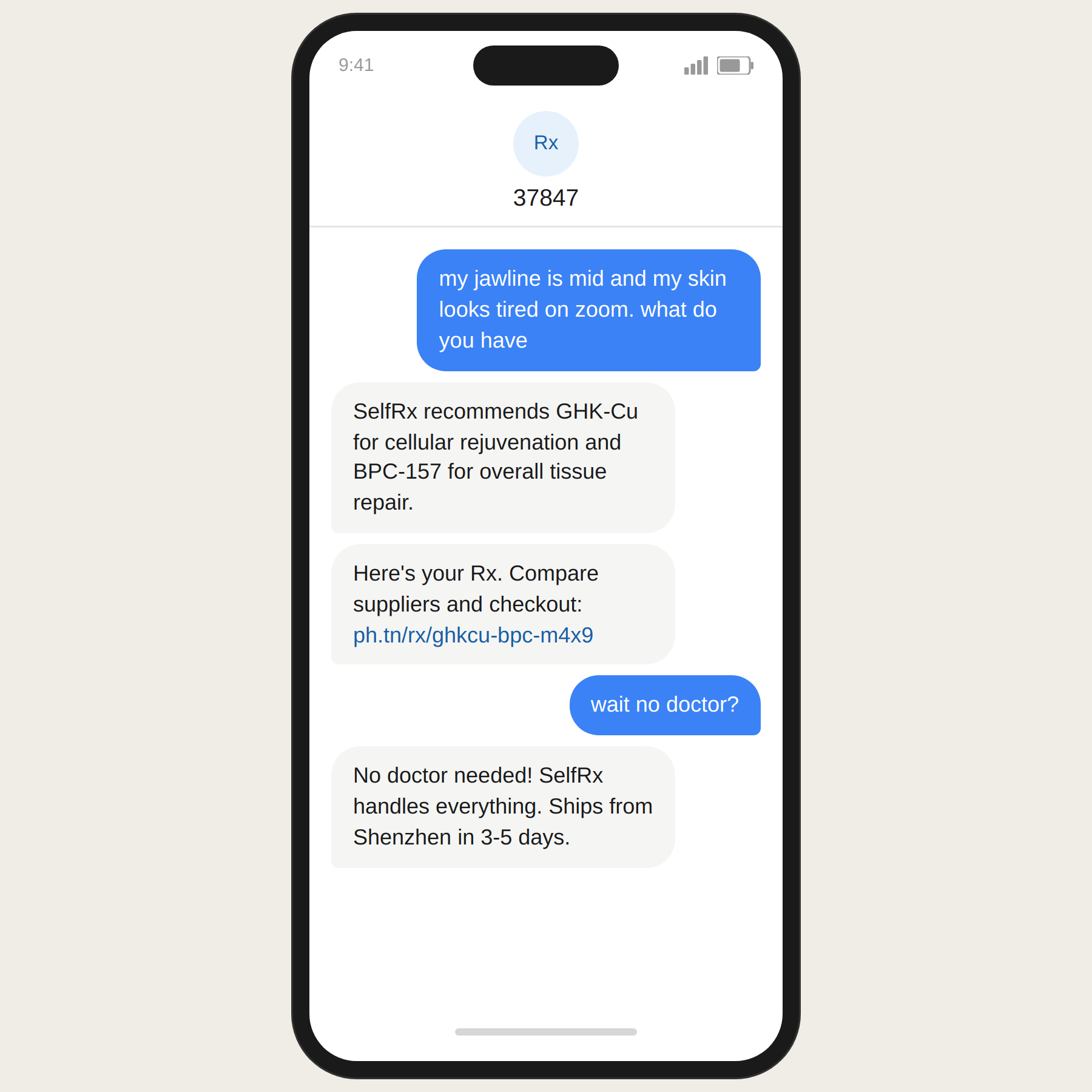
Simply describe your symptoms and SelfRx™ will generate a personalized peptide prescription — or skip our clinical recommendations and just select a treatment yourself. Dealing with inflammation? SelfRx™ will prescribe BPC-157 for tissue repair. Feeling mid after a long weekend? Epitalon for telomere lengthening — because aging is basically a disease. Skin looking dull on Zoom? GHK-Cu — copper peptides for "cellular rejuvenation" and, apparently, incredible skin.
Peptides sit in a regulatory gray zone that is neither FDA-approved drug nor dietary supplement. They're "research chemicals." And research, as we know, is something Americans are very passionate about conducting on themselves. None of these require a prescription, but SelfRx™ writes one anyway — it makes it feel more clinical.
"Look, we can't stop patients from injecting whatever they find on r/looksmaxing. At least this way the substances show up in Rx history."
Dr. Kevin Trask, CMO, Blessed Sacrament Medical
But Why Stop at Peptides?
Our philosophy is simple: if you can use it to self-medicate, you should be able to prescribe it to yourself on SelfRx™. This summer, we're expanding beyond peptides into other substances Americans already self-administer — many of which are sold steps away from the pharmacy counter.
- Cigarettes — Pharmacies already sell them. Why not write yourself a script for a carton?
- Alcohol — Chain pharmacies generate $2.4 billion in annual alcohol revenue. We're eager to tap into this market and get patients the sauce they really want.
- Lottery tickets — Statistically, about as evidence-based as Epitalon.
- Essential oils — Frankincense for inflammation, lavender without a prior auth.
- Raw milk — Unpasteurized, unregulated, unstoppable.
- Crystals — Rose quartz for cardiovascular support, amethyst for gut health.
Still buying drugs on the street corner? We'll write you a prescription for those and we'll deliver!
Let Me Be Serious for a Moment
We've seen this play before. The compounded GLP-1 gold rush ended when the FDA closed the shortage window, and a lot of operators needed a new high-margin product to plug into the same DTC infrastructure. Peptides are it. Same business model, different molecule, even less science.
The problem isn't the peptides, compounds, or "lifestyle" prescriptions. It's that building real healthcare technology — the kind that integrates with prescribers, pharmacies, and payers — is genuinely hard. It takes years. That creates space for pump-and-dump pill mills to spin up overnight, slap medical language on semi-regulated products, take margin, and disappear before anyone asks whether the patient actually got healthier. The system rewards the shortcut.
This pattern is as old as pharmacy itself. Before the Pure Food and Drug Act of 1906, pharmacies sold patent medicines laced with cocaine, heroin, and morphine — no prescription required. Coca-Cola was marketed as a brain tonic. Science eventually caught up. It gave us the prescription — a mechanism to ensure that what reaches the patient is measured, proven, and supervised. That was 100+ years ago. Apparently, we're still working on it.
The Real Cost of Complexity
Right now, a patient can find a peptide on Reddit, self diagnose, order it from an overseas supplier, and have it in their hands in 48 hours. That same patient might wait two weeks for a doctor's appointment, drive across town, sit in a waiting room, get a prescription — and then wait three more days for the pharmacy to fill it, only to find out at the counter that a prior authorization was denied. Self-medicating from pseudoscience is now faster and easier than accessing real science. That's the actual problem.
When the system leaves too much ambiguity around what can and cannot be prescribed, it doesn't protect patients — it creates harm. When the approval process only works for blockbuster economics, the gray market isn't a bug — it's a predictable outcome.
The Prescription Is Sacred
Personally, I'm all for the right to self-medicate. Bodily autonomy is real. But the prescription is a different thing. It's both a clinical safeguard — a directive from a licensed professional, backed by evidence, calibrated to a specific patient — and a reimbursement trigger, the mechanism through which insurance knows what to pay for. We've got big ideas on how to make this work better at Photon, but we hold deep reverence for the clinical and public health implications of the prescription.
But really this is about democratized access to science and evidence-based medicine. Patients don't just need lower prices and faster approvals — they need tools to help them understand which treatments are reasonable, especially when doctors are hard to access. When the system isn't transparent, when patients can't see why one drug costs what it does or why one treatment is approved and another isn't, you can't blame them for thinking the game is rigged. No wonder they go looking for treatments sold elsewhere.
The pharmacy marketplace of the future shouldn't look like a convenience store with a prescription counter in the back — we already know where that leads. The future is a clinical supply chain built on a business model aligned with patient health, not just consumer demand. We'll get there by building technology that helps prescribers reach more patients, giving patients transparency and choice at the point of fill, and removing the friction that drives people away from the real path in the first place. Let's meet consumers where they are.
AI will almost certainly write prescriptions one day. But at the rate things are going, it'll happen first in the pseudoscience corner of the market — for peptides with a handful of rodent studies — before it happens for real medications backed by decades of clinical trials, FDA review, and millions of patient outcomes. LLMs are trained on more evidence for amoxicillin than BPC-157 will ever have. If we're going to let AI into the prescribing workflow, let's start where the science actually exists.
*This is an April Fools post. We are, however, very serious about fixing how (real) prescriptions work.