Did you know your prescription doesn't have just one price? It can have a dozen prices.
The same medication, prescribed the same day, can cost $12 at one pharmacy and $47 at another a few blocks away. These prices can change depending on your insurance, what day you decide to fill, or what kind of generic the pharmacy has in stock. They might be cheaper using discount cards or manufacturer programs outside of your insurance, which many people with commercial insurance plans don’t realize. They can even change based on your zip code, for the same drug, at the same pharmacy.
And then there are other key pieces of information that you might wish you had when making a decision, like if the medication is in stock, how long it will take to fill, and more. One pharmacy has it in stock; the other has to order it. One can fill it in an hour; the other won't have it ready until tomorrow morning. All of this is true right now, for the prescription your doctor just wrote, yet patients today are routinely asked to provide their “preferred pharmacy” with no information other than what pharmacy is closest.
We accept this experience with our prescriptions even though we'd find it unacceptable anywhere else. You wouldn't book a flight without seeing the fare, or without knowing if there's an available seat on the plane. You wouldn’t authorize a car repair without getting a quote, confirmation that the shop can get the parts, and an estimate for when you'll have your car back. In fact, you wouldn't (and shouldn't!) make any important purchase without knowing the price. Yet that's exactly how the last mile of American healthcare works: patients are routinely asked to make decisions about their health without complete information, including cost.
Now imagine if you had. Imagine that the moment your prescriber hit "send", you could see, for your exact drug and your exact benefit, what it costs at the three pharmacies closest to you. Which of them has it on the shelf today. Which can have it ready before you head home from your appointment. And imagine you could choose, or change your mind, with a single tap.
For most patients, that moment doesn't exist. Not because it's technically hard to provide, but because the institutions holding this data haven’t been incentivized to share it.
A Brief History of How We Got Here
In 2021 and 2022, federal transparency rules began prying open the black box around hospitals and health insurance plan pricing. Prescription drug pricing was supposed to be included, but then trade groups pushed back and took the government to court. Eight days later, regulators put the requirement on hold, citing “stakeholder concerns” and overlapping reporting requirements.
The information exists. The incentive to show it to patients does not. The infrastructure that routes most prescriptions today is entangled, by ownership and by economics, through companies that stand to benefit when prices stay hidden and prescriptions stay put. PBMs earn on spread pricing, all but guaranteeing the largest margins, while pharmacies earn on captured volume. While the ever-growing vertical integration of PBMs, insurance companies, and pharmacies into large conglomerates is supposed to create meaningful efficiencies, it also creates powerful incentives for prescriptions to stay within those systems. Rarely are savings passed through to patients.
Look no further than Surescripts, the monopoly in e-prescribing, which launched its own price-transparency marketplace, Script Corner, earlier this year. It was shut down almost immediately. It makes sense if you think about it: price transparency across multiple pharmacies in the hands of patients challenges the status quo. For incumbents, the fear is that patients will switch pharmacies, and that prices in general will be driven down by marketplace economics, compressing margins across the supply chain.
Quick Fact Check
This fear is somewhat overstated. Photon marketplace data shows that patients with a preferred pharmacy remain loyal to that pharmacy more than 80% of the time. Convenience often matters more than price, especially for relatively inexpensive generics. Patients switch pharmacies when there is a real reason to do so - their pharmacy is closed, an urgently needed medication is out of stock, or - especially for expensive medications like GLP-1s - another pharmacy has lower prices that can materially improve access and adherence.
Photon is built differently. We don't own a pharmacy. We aren’t owned by a PBM. We don't make more money when a patient pays more, or when a prescription goes somewhere they didn't choose. Our incentives are simple: give patients the information they need to make smart choices. We only win when patients win.
The Photon Marketplace
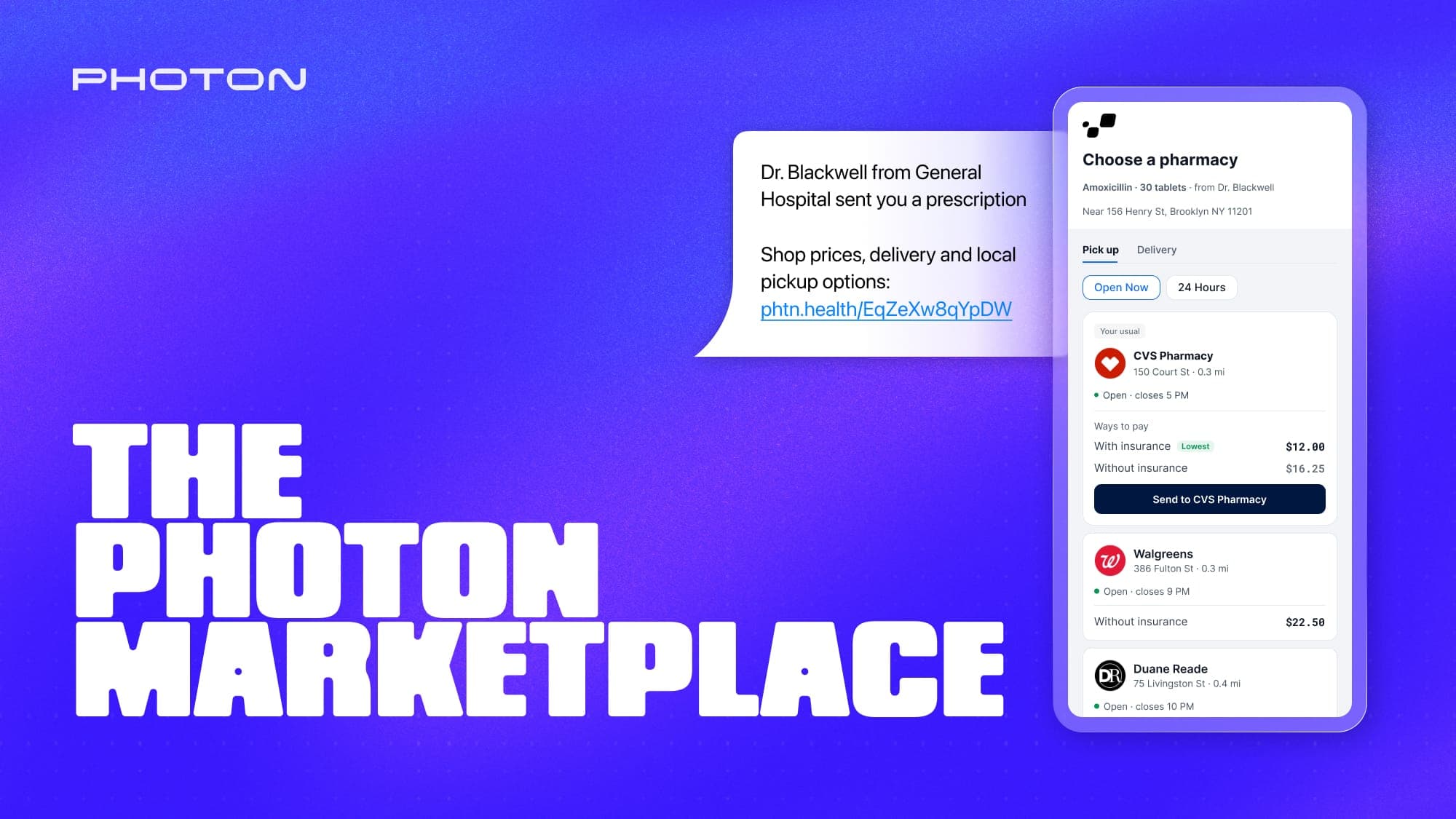
Our mission is to put pharmacy choice and price transparency in front of you, at the moment it matters most — right after a prescription is written, but before it goes anywhere.
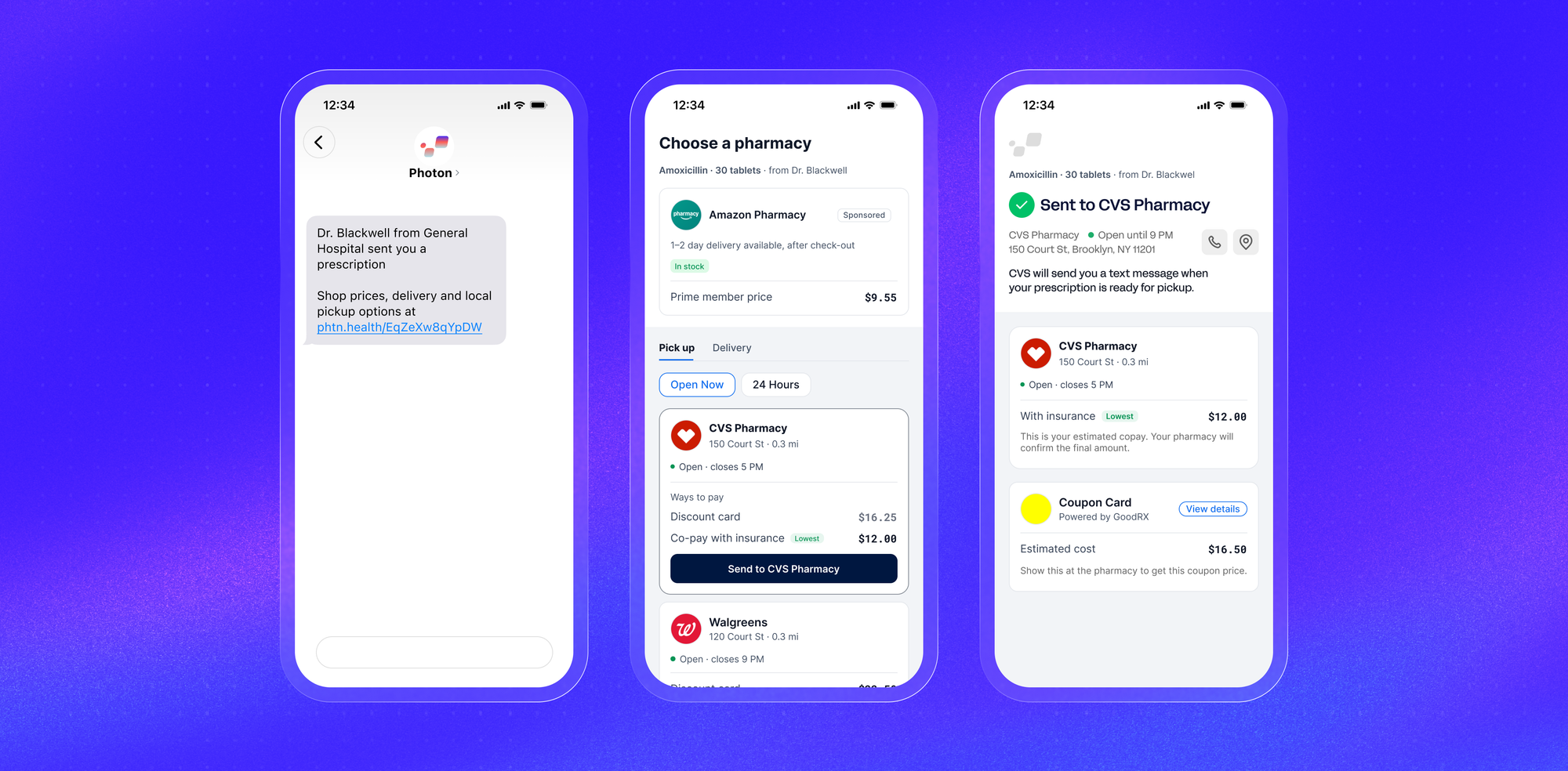
The experience is simple:
- Your provider writes your prescription
- You get a text message right away, with a link to view your pharmacy options
- You browse pharmacies near you, comparing across local pick up and delivery options, and pricing options that we have available: discount cards and/or insurance, if we have your benefits on file
- You select your desired pharmacy
- We route your prescription to your pharmacy
- If you want to change your pharmacy or have any issues, you do so from the same link, or simply text us for support.
No more naming a "preferred pharmacy" blindly, with nothing to go on other than proximity. Cheapest, fastest, in stock: the decision is finally yours. Transparency isn't just something we advocate for. It's the product itself.